How to drive in snow and ice: chains, speed and tips for safe travel
Traveling to **Bariloche or Mendoza by car in winter** allows you to explore the city and its main attractions with greater freedom, but it also requires planning. Snow completely transforms Patagonia's landscapes and can change, within a matter of hours, the condition of the roads.
Bariloche and Mendoza are once again positioning themselves among the most popular destinations for families, couples and international travelers. However, the high prices of tourist packages lead many visitors to organize the trip on their own, compare accommodations and evaluate options to **rent a car in Bariloche and Mendoza.
Having a vehicle allows you to discover iconic places without relying entirely on excursions, private transfers or public transport schedules.
In the following article by Rentennials we provide you with the best information to plan your own itinerary and explain why renting a car is the best option for doing so. The key is not just having a car: you need to choose the right vehicle, check the weather, carry chains and adapt your driving to snow and ice.
Discover all available options at Rentennials.
Traveling by car during winter lets you discover incredible landscapes, explore mountain destinations with freedom and organize each stop at your own pace. However, when snow, ice or sub-zero temperatures appear, driving requires more preparation and caution.
If it's your first time facing a snowy road, feeling some concern is perfectly normal. Traction decreases, braking distance increases and some common maneuvers can cause the vehicle to lose stability.
The good news is that you don't need to be an expert driver to travel safely. The key lies in checking the vehicle, consulting road conditions, carrying the right equipment and driving with smooth movements.
In this guide by Rentennials we explain how to drive in snow, when to use chains, how to handle a slope and what to do if the car loses traction.

How to drive safely in the snow?
The convenience depends on the type of trip. If the plan is only to explore the city center and take organized excursions, it may not be necessary to use a vehicle every day.
On the other hand, renting a car is especially useful when:
- You travel with children, elderly people, or a lot of luggage.
- You stay far from the city center.
- You want to visit different mountains and lakes.
- You carry snow clothing or equipment.
- You want to organize your schedule freely.
- You travel with family or a group and can split the cost.
- You want to adjust the itinerary based on the weather.
Additionally, having a vehicle allows you to stop at viewpoints and explore attractions at your own pace. Before booking, you can check this guide on the best options for renting a car in Bariloche and renting a car in Mendoza
To drive in snow, you must reduce speed, increase the safety distance, and avoid sudden acceleration, braking, or sharp steering movements.
Snow completely changes the contact between the tires and the road. Therefore, even if a route looks passable, it does not mean it can be driven the same way as a dry road.
Before proceeding, observe:
- The condition of the surface.
- The presence of tracks from other vehicles.
- The available visibility.
- The instructions from road personnel.
- Signs requiring chains.
- Sudden temperature changes.
There is no universal speed for driving in snow. The safe speed will always depend on the road conditions, visibility, the vehicle, and current restrictions. In some cases, even moving slowly may be unsafe and the right decision will be to stop at an authorized location.
Why is ice more dangerous than snow?
Ice can be difficult to detect and considerably reduces traction, especially on bridges, curves, shaded areas and during the early morning hours.
One of the greatest risks is what is known as "black ice": a thin, nearly transparent layer that can be mistaken for wet asphalt. It typically forms when moisture freezes on the road surface.
Pay special attention:
- During the early morning hours.
- At nightfall.
- On bridges and overpasses.
- On curves that remain in the shade.
- Near bodies of water.
- When the temperature is near or below 0 °C.
If you suspect there is ice, reduce your speed before reaching the area, keep the steering wheel steady and avoid braking while crossing it.

How to put on snow chains step by step
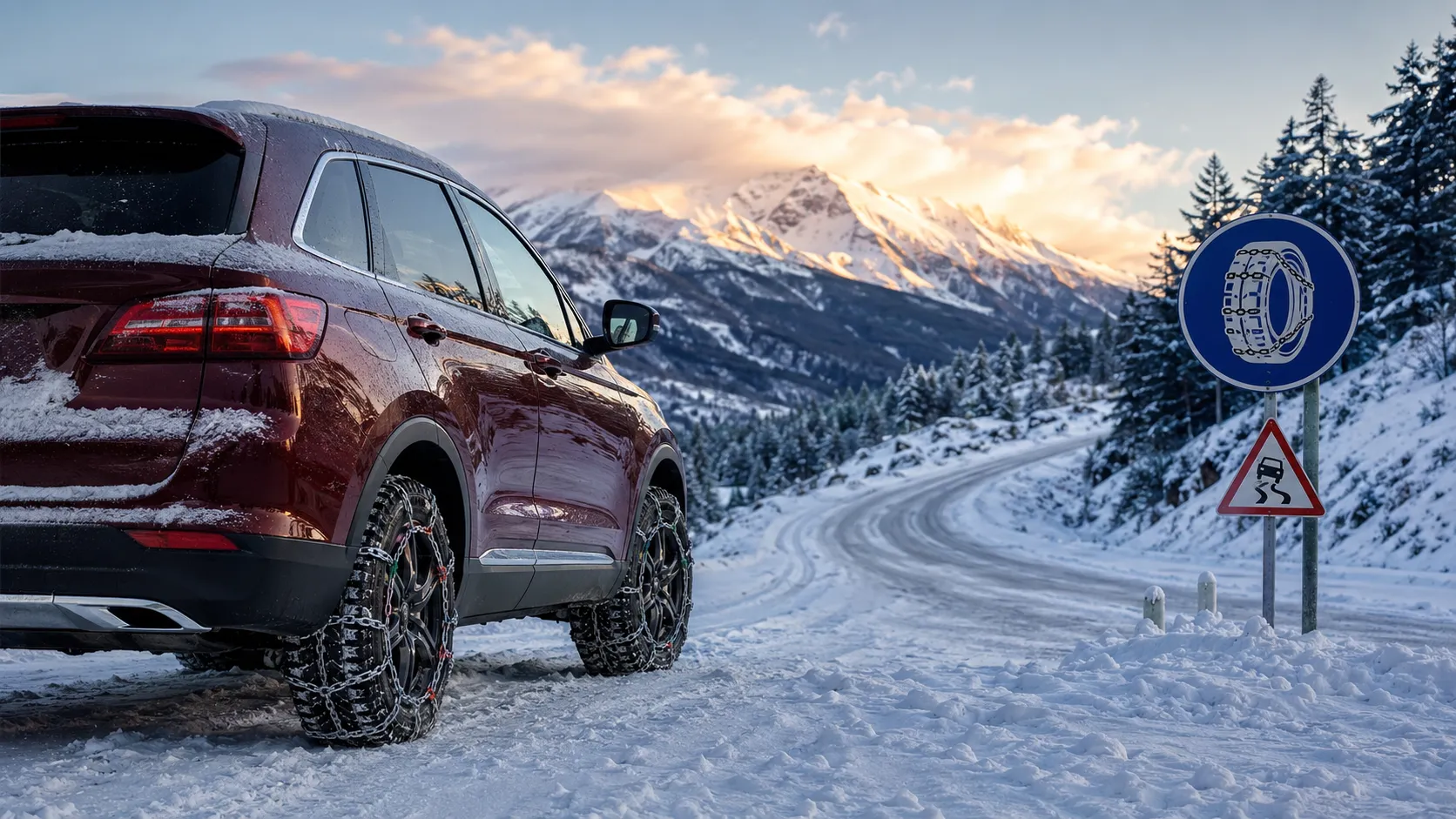
Chains improve traction when driving on compacted snow or ice. However, they must be compatible with the tire size and installed correctly.
Before the trip, practice installing them in a dry, safe location. Learning to put them on during a storm, in cold weather and low visibility, can be complicated.
1. Stop in a safe place
Do not install chains in the middle of the road, a curve, a bridge, or a steep slope. Find an authorized area and turn on your hazard lights.
Before getting out, put on your reflective vest and make sure all passengers remain protected.
2. Identify the drive wheels
Chains are installed, at minimum, on the wheels that receive power from the engine:
- Front-wheel drive: front wheels.
- Rear-wheel drive: rear wheels.
- All-wheel drive or 4x4: follow the vehicle manual.
On some all-wheel-drive models, the manufacturer may specify chains on a specific axle or on all four wheels. Never improvise, as incorrect installation can damage tires, suspension, brakes, or sensors.
3. Untangle and lay out the chains
Spread them out on the ground and check that there are no twisted links, damaged cables, or broken tensioners. The side indicated by the manufacturer must be oriented correctly.
4. Wrap the tire
Pass the chain behind the wheel or place it over the tread, depending on the model. Close the inner system first and then the outer one.
5. Tighten the tensioners
The chain must be centered and secure, with no loose parts that could hit the fender. Use all the tensioners included in the kit.
6. Drive a few meters and check
After traveling a short distance, stop again in a safe place and re-tighten the chains. It is normal for them to settle during the first few meters.
7. Drive slowly
Respect the speed limit indicated by the chain manufacturer. Avoid sudden acceleration, hard braking, and sharp turns.
8. Remove them when the snow or ice ends
Chains should not be used for long stretches on clear asphalt. In addition to wearing out, they can damage the tires and affect vehicle control.

When is it mandatory to carry or use chains?
The requirement depends on the route, jurisdiction, weather conditions, and the authorities' provisions. A sign or road checkpoint may order their immediate installation.
In Andean and Patagonian regions, it is common for carrying chains during the winter season to be required, even if there is no snow at the start of the journey. Having them in the trunk does not guarantee passage: if the authority instructs you to install them, they must be correctly fitted.
The National Road Safety Agency recommends checking before departure whether the use of chains, winter tires, or studded tires is mandatory. It also advises following existing tracks during heavy snowfall and avoiding overtaking or sudden maneuvers. You can consult their official recommendations for driving in snow.
Speed, braking and safety distance
On a snowy or icy road, all actions must be performed gradually.
Reduce your speed before the curve
Brake while the vehicle is still straight and before entering. Inside the curve, maintain a steady speed and turn the steering wheel smoothly.
Increase your following distance
Leave much more space than on a dry road. That extra gap allows you to brake gradually and react if the vehicle ahead loses traction.
Do not use your usual following distance as a reference: on ice, the car may keep moving even after you have applied the brakes.
Take advantage of engine braking
On descents, use a low gear to control speed without relying exclusively on the brake pedal. Avoid coasting in neutral.
If the vehicle has an automatic transmission, select snow, winter mode, or a low gear ratio when the model allows it.
Do not pump a brake with ABS
In a modern vehicle equipped with ABS, apply firm and sustained pressure. It is normal to feel vibrations in the pedal: it means the system is working.
Do not disable stability or traction systems unless the manual indicates a specific situation.
How to start on a snowy slope
To start moving on an uphill slope you need to transmit force gradually. Sudden acceleration will cause the wheels to spin and polish the surface even further.
In a manual car:
- Straighten the wheels.
- Use second gear if the vehicle and the slope allow it.
- Release the clutch progressively.
- Accelerate only as much as necessary.
- Maintain a steady path.
In an automatic, activate snow or winter mode. If that function is not available, accelerate with extreme smoothness.
Before going uphill, leave enough space from the vehicle ahead. Avoid stopping halfway up the slope. If the car does not move forward, do not insist on accelerating: reverse only if it is safe and look for assistance or an authorized alternative.
What to do if the car loses grip
The first thing is to stay calm and look toward the direction you want to go. An overreaction can make the skid worse.
If the front end stops responding:
- Gently release the accelerator.
- Avoid increasing the steering wheel turn.
- Slightly reduce the angle until grip is restored.
- Do not brake abruptly.
If the rear end slides:
- Look toward the safe exit.
- Gently steer the wheel in the direction of the slide.
- Avoid sudden movements.
- Correct the steering wheel once the vehicle regains stability.
Two-wheel drive, all-wheel drive and 4x4: which is best for snow?
Simple traction
A front-wheel-drive vehicle can perform correctly on authorized roads if it uses appropriate tires and chains when necessary.
Rear-wheel drive may require greater care when accelerating, especially on slopes or curves.
All-wheel drive or AWD
It automatically distributes power between both axles and can make starting and driving easier. However, it does not reduce braking distance on its own.
4x4 traction
It is useful in deep snow, steep slopes, or low-grip surfaces. Some models allow you to select different traction modes.
Having a 4x4 does not make the vehicle invulnerable. All cars depend on the contact of their tires with the ground and can slide on ice.

What to check before leaving
A preventive check can prevent you from getting stranded in an isolated location. Check:
- Tire condition, tread, and pressure.
- Compatibility and condition of snow chains.
- Brakes and brake fluid.
- Battery.
- Front, rear, and fog lights.
- Wiper blades and antifreeze windshield washer fluid.
- Engine coolant and antifreeze.
- Heating and defroster.
- Sufficient fuel.
- Spare tire and tools.
- Required documentation and vehicle coverage.
Argentina's National Road Authority (Vialidad Nacional) advises keeping the tank full even on short trips and paying special attention to brakes, lights, and heating. Its Comprehensive Winter Maintenance Plan covers tourist corridors in Mendoza and Patagonia.
Essential items for winter travel
Prepare a basic kit that includes:
- Compatible chains and waterproof gloves.
- Reflective vest.
- Flashlight with batteries.
- Extra coat and blanket.
- Water and non-perishable food.
- Portable phone charger.
- Small shovel.
- Ice scraper.
- Jumper cables.
- First aid kit.
- Regulation warning triangles and fire extinguisher.
For families, also make sure that children are using the appropriate child restraint system. Store luggage securely to prevent it from shifting during a maneuver.
Where to check road conditions
The general forecast is not enough to determine whether a road is open. A snowfall can lead to restrictions, assisted transit, mandatory chain use, or temporary closures.
Before setting out and during stops, check:
- The official road status from Vialidad Nacional.
- The forecast and alerts from the National Meteorological Service.
- Provincial reports from Vialidad, Civil Defense, or border crossings.
- Instructions from Gendarmería and personnel present on the road.
Do not rely solely on a navigation app or an outdated social media post. Official reports can change several times throughout the same day.
Rentennials Checklist Before Entering a Snow Zone
Before moving forward, do this quick check:
- Is the route officially open?
- Does the forecast allow you to complete the trip?
- Do you have chains in the correct size?
- Do you know which wheels to put them on?
- Do you have enough fuel?
- Does your phone have battery and maps available?
- Are all passengers dressed warmly?
- Do you know a safe place to stop?
- Is the vehicle suitable for the planned road?
If any answer is no, resolve it before continuing. Changing the schedule, route, or vehicle is also part of responsible driving.
Are you planning a trip to the snow?
Find on Rentennials vehicles suitable for exploring mountain destinations and arrange your rental directly from the platform.
If you are still choosing a destination, you can discover where to ski in Mendoza, check when winter break is in Argentina or find out what to do in Bariloche when it rains.
Frequently asked questions about driving in snow
Are chains placed on all four wheels?
Not always. At a minimum, they are placed on the drive wheels, but AWD and 4x4 vehicles must follow their manufacturer's instructions.
Does a 4x4 truck need chains?
Yes, it may need them. 4x4 traction helps move forward, but it does not eliminate the risk of skidding or replace a requirement from the authorities.
Is it advisable to disable traction control?
In general, it should remain enabled. Some manufacturers allow exceptions for getting out of deep snow. Always check your vehicle's owner's manual.
What gear should be used to descend a snowy slope?
Use a low gear to take advantage of engine braking. Descend slowly, without putting it in neutral and avoiding sudden braking.
What should I do if it starts snowing during the trip?
Reduce your speed, increase your following distance, and find a safe place to check road conditions. If visibility worsens, do not continue.
Is it safe to follow other cars' tracks?
It can improve traction during heavy snowfall, as long as the road is open. Do not follow tracks that leave the road or cross deep snow accumulations.
Frequently Asked Questions About Renting a Car
What is Rentennials and how does it work?
Rentennials is the leading carsharing platform in Latin America. We are transforming the way vehicles are rented by offering a completely different experience from traditional rental companies, which are characterized by unclear contracts, hidden costs, high prices, and impersonal service.
At Rentennials we fight against that so you can enjoy your trip the way you deserve. We stand out for our transparency, personalized attention, fair prices, and a 100% digital and simple process, always prioritizing the safety of our users.We want you to enjoy true freedom of movement, with a modern and hassle-free rental experience.
Join the Rentennials revolution and discover how we are changing mobility around the world.
We recommend downloading our app from Google Play or the Apple Store, registering, and you will immediately access a complete catalog of vehicles based on the area you have selected.
How do I rent a vehicle?
Bookings must be made through our website or App.
The steps are:
- Filter your search by city, dates, and time to find the ideal vehicle.
- Select and send a request!
- First, we will ask you to register by filling in some personal details.
- Once the request is sent, the host must accept it so you can pay a booking deposit. (You can send multiple requests to different vehicles; some will have an instant booking option.)
- With the payment, you secure your vehicle reservation. The remaining amount will be paid directly to the host upon receiving the vehicle.
- Don't forget to complete the check-in in advance before the handover!
What requirements do I need to rent?
- Be over 25 years old.👉 In Argentina we also rent to drivers aged 22 to 25, by paying the reduced deductible co-insurance, which lowers the security deposit and the deductible in case of damage.
- 2. Have a valid driver's license.(Make sure to bring the physical license. We do not accept learner's permits).
- 3. Leave a security deposit.You can do so by credit card (temporary hold 48 hours before the start of the rental) or, for eligible vehicles, via bank transfer.
- 👉 In Peru, for certain vehicles, it is possible to rent without a security deposit, provided that our support team has previously validated the driver's profile as eligible for this option. The platform will clearly indicate which vehicles have a zero deposit.