1- Zuccardi Winery
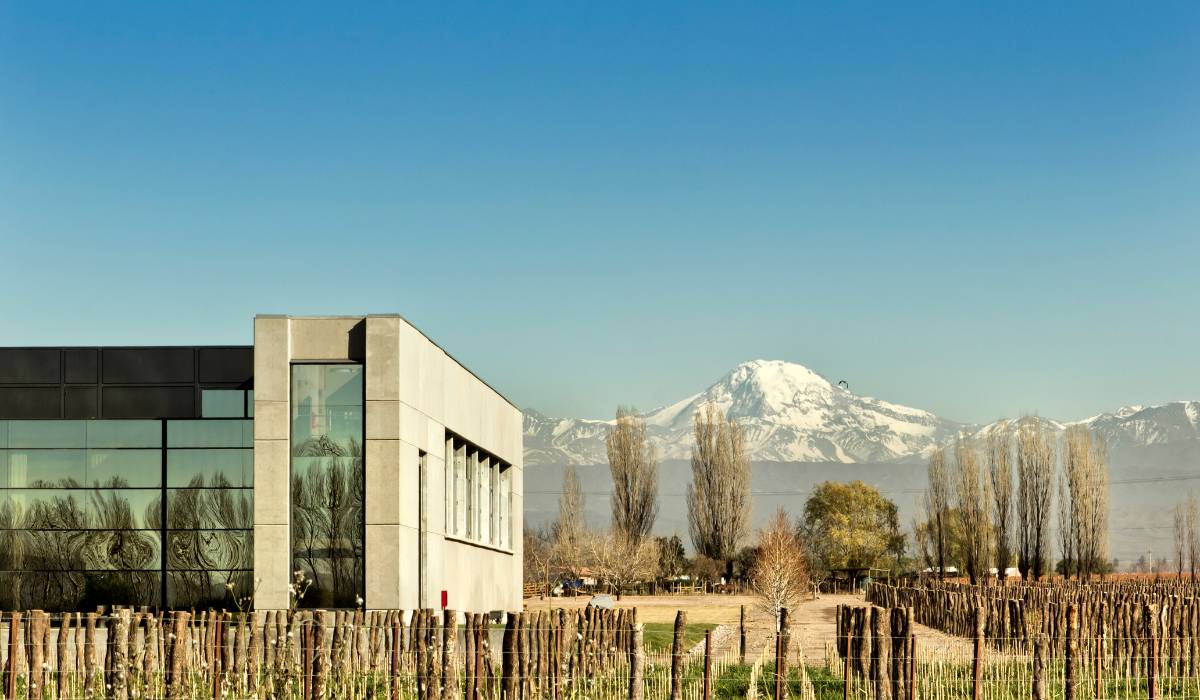
Bodega Zuccardi, a unique and special place, is a family winery and one of the most respected and innovative in the country, known for its focus on terroir and sustainability. It was built in 2013 and inaugurated in 2016. The building is a representation of the mountain, which defines both the climate and the soils of the region.
Built with natural elements, local stones, round, white and calcareous. It is made of concrete from the outside in, from the stone walls to the concrete tanks without epoxy coating where the wines are made.
The tanks and amphoras are the result of years of experimentation in the search for the ideal vessel, until reaching the truncated-conical shape that allows for a more natural process in the musts and wines.
The winery has three main estates in:
- Maipú
- Valle de Uco
- Patagonia.
Each estate has its own microclimate and unique soil conditions, allowing the production of a wide range of wines, from classic Malbecs to more experimental blends.
Some of the most popular wines are:
- Zuccardi Santa Julia Varietals
- Zuccardi Piedra Infinita Cabernet Sauvignon
- Zuccardi Q Malbec
They have received important recognition, such as the Best New World Winery award of 2022, by the prestigious American magazine Wine Enthusiast, positioning them as the best-known winery outside the United States and Europe.
Zuccardi is deeply committed to sustainability, using solar energy to power its operations, recycling water and waste. They are also strongly focused on biodiversity, planting more than 100,000 native trees on their properties.
Zuccardi produces award-winning wines and being a popular tourist destination, the winery offers guided tours and tastings, a restaurant and a shop.
The "Piedra Infinita" restaurant opened its doors in March 2016. Located in Paraje Altamira, Valle de Uco, facing the majestic Andes Mountains, it has a capacity of 50 covers, where guests can enjoy a 4-course menu crafted with regional products and a gourmet expression, paired with the house's own wines.
Open from 12:30 to 15:00 Monday through Sunday for lunch service. Thursday, Friday and Saturday at 20:00 for dinner service. We recommend booking in advance to secure your spot.
For visits and tastings, guests can explore the winery spaces as well as the vineyards, discovering the characteristics and particularities of the different soils that give the wines their identity.
Tourism: Open Monday through Sunday. Visit and tasting schedules: 09:30 – 11:00 – 12:30 – 15:30
All programs require prior reservation.
2- Bodegas Bianchi
A Winery with a Family Heritage that projects itself with its values of tradition, quality, prestige, innovation and contemporaneity in Argentine viticulture, with an unwavering quality and excellence across all its products.
Located in the historic terroir of San Rafael and in the Uco Valley, in the province of Mendoza, they are Argentina's heritage winery, globally recognized for their long history producing excellent wines and sparkling wines.
Their history begins in 1928, when Valentín Bianchi managed to fulfill one of his greatest dreams: owning his own vineyard and opening a winery he named El Chiche, "the small winery of great wines".
Determined to make the best wines in the country, he imported European grape varieties and adapted them to the climatic and orographic characteristics of the San Rafael region, forging the family winery that would become Argentina's authentic heritage: Bodegas Bianchi.
Don Valentín's legacy was carried on by his son, don Enzo Bianchi, who followed his father's vision, pursuing innovation and the highest quality in his wines. Bold and groundbreaking, he was the creator of avant-garde reds and whites that set trends in the style of new Argentine wines. From his knowledge and intuition were born Don Valentín Lacrado and Bianchi Particular, among other iconic labels of the national wine industry.
Don Enzo's three children: Valentín, Raúl and Sylvia, together with their cousins, the Stradellas, shaped this great wine family and continued the founder's legacy, earning international recognition and awards.
Bodegas Bianchi is today a global brand present in more than 40 countries, representing the values and quality of Argentine wine throughout the world.
With over 90 years of history and across four generations, the Bianchi Family keeps intact the values and historical legacy of the family, embodied in a line of unique wines and in the pursuit of new flavors for both the local and international market.
You can purchase their wines through their website, learn more about their history and book your visit.
3- Salentein Winery
Salentein, the first Argentine Winery that merges wine, art, gastronomy and the good life: «We founded a Winery, we transformed a region.»
The winery is located at an altitude of 1,200 meters, right in the center of the vineyards, with more than 49 hectares of native desert habitat that were preserved and form part of the landscape. The western horizon is dominated by the nearby snow-capped Andes, which rise to over 6,100 meters.
This magnificent winery was designed with both form and function in mind. The cross-shaped layout allows for careful handling of the grapes and wine, minimizing the distance that both the fruit and its product travel throughout the various stages of production. Each wing constitutes in itself a small winery with two levels.
The four wings converge in a circular central chamber, similar to an amphitheater, built with the classic temples of antiquity as inspiration.
The underground cellars are located nine meters below ground. Viewed from the upper level, the floor of the central chamber displays a significant design with strong symbolic content: it is based on the compass rose, with each of its points oriented toward the cardinal directions, representing its relationship with the rest of the world.
It features three tasting rooms: one central and two side rooms, located underground, at the same level as the wine cellars.
Beauty and function converge in the Primus Room. This exclusive room is one of a kind in the country and contains 12 French oak barrels of 7,600 liters equipped with a controlled refrigeration system, where the limited edition wine line of Bodegas Salentein is produced, only in harvests where the fruit is of exceptional quality.
Its three estates are located between 1,050 and 1,700 meters above sea level. The San Pablo estate is home to the highest vineyards in the province, and some of the highest in the world. The great altitude of the estates offers two key advantages: water and temperatures.
The soils of the three estates vary, but are generally alluvial and sandy, resting on a bed of stones. These characteristics promote permeability and drainage. These factors allow, through regulated irrigation, control over both vine vigor and grape quality.
The climate of the estates is continental and monsoon-influenced, meaning dry and sunny practically every day of the year. Annual rainfall levels are low: 204 millimeters on average, mainly in summer. It snows an average of three times per year, in winter. This climate allows the grapes to grow healthy, avoiding the need for treatments against diseases caused by humidity or insects.
Likewise, the region's thermal range, which reaches 16°C, contributes to the health of the vines.
The Bodegas Salentein estates are irrigated with pure meltwater from the Andes, coming directly from streams or from the water tables found beneath the vineyards. The clarity and purity of the water produces a low pH in the grape, greater acidity, and wines with more color and aging potential.
The Salentein restaurant is a magnificent place to enjoy wine and gastronomy with an unmatched view and natural surroundings. Conceived around gastronomy through its wines under the guidance of our executive chef Matías Gil Falcón, achieving the finest pairings.
The kitchen's identity highlights producers from the Uco Valley, seeking respect for local ingredients and paying homage to the roots of Andean culture. It is a space to enjoy different tasting menu options, or à la carte, with the possibility of trying all the wines from the winery.
It is open every day from 12:00pm to 3:00pm, with prior reservation.
For reservations, inquiries and rates:
E- mail: espaciosalentein@salentein.com
Reservations: http://www.bodegasalentein.com/reservas
Salentein also features inns, with a total of 14 rooms surrounded by gardens, vineyards, a seasonal swimming pool with views of the Andes mountain range and much more, to enjoy various activities such as:
– Visit to Bodegas Salentein.
– Visit to the Killka art gallery.
– Access to the Chapel of Gratitude.
Guests of Posada Salentein receive benefits at the Espacio Salentein restaurant and at the wine shop.
Pets are not accepted.
Reservations: posada@salentein.com
Whatsapp 24 hours: +549 261 6860153
4- Norton Winery
Norton has five vineyards spread across the main terroirs of the province of Mendoza, at the foot of the Andes mountain range, all of them within a privileged area known as the Primera Zona, renowned for the quality of its grapes. The vineyards are planted with a variety of grape varieties, including Malbec, Cabernet Sauvignon, Merlot, Chardonnay and Sauvignon Blanc.
According to Norton, it is not only the geographical location that influences the quality of the wines, but also the age of the vines.
It is one of the largest and most respected wineries in Argentina and produces a wide range of wines, from Malbec to Cabernet Sauvignon and Chardonnay. It is also known for its innovative winemaking practices, its commitment to sustainable viticulture and its attractive tourist offerings.
Norton was founded in 1900 by engineer Edmundo Norton, an English immigrant who was inspired by the beauty of the Mendoza Valley and the potential for great wines. It quickly became one of Argentina's leading wineries and its wines are now exported to more than 60 countries around the world.
It produces a wide range of high-quality wines, from entry-level to premium. Some of the most popular wines are:
- Malbec DOC: A classic Argentine Malbec with aromas of black fruits, spices and chocolate.
- Libre Malbec: A more modern Malbec with bold flavors of red berries, blackberry and plum.
- Altura Malbec: A single-varietal Malbec from high-altitude vineyards, with concentrated flavors of black fruits, smoke and spices.
- Select Pinot Noir: A Pinot Noir with aromas of red berries, rose petals and spices.
- Talisman Cabernet Sauvignon: A Cabernet Sauvignon with aromas of black fruits, cedar and tobacco.
Norton is also known for its innovative winemaking practices, using a variety of techniques to produce wines with complex flavors and aromas, such as a technique called cryoextraction to extract the aromas and flavors from the grapes without extracting harsh tannins.
They are strongly committed to sustainable viticulture. The winery uses a variety of practices to reduce its environmental impact, such as drip irrigation, composting and cover crops.
It is a popular tourist destination offering a variety of tours and tastings.
You can enjoy the winery's restaurant, which offers a regional cuisine menu paired with their own wines.
Through their website you can learn more about their history, their wines and even purchase them online. (54261) 490 – 9700
5- Catena Zapata Winery
Nicolás Catena Zapata has managed to position Argentina on the world wine map, focusing entirely on quality.
Great wines are born in the vineyard. His vision is to produce intense and unforgettable wines, truly expressive of the terroir. The story of Catena is the story of Argentine wine.
Founded in 1902, Bodega Catena Zapata is recognized for its pioneering role in reviving the Malbec variety and discovering extreme high-altitude terroirs at the foot of the Andes.
Adrianna Vineyard located at an altitude of nearly 1,500 meters above sea level, has been called the Grand Cru of South America.
Awards and Distinctions Decanter Man of the Year, Wine Spectator Distinguished Service Award, Der Feinschmaker Award, Wine and Spirits and Wine Enthusiast Winery Awards.
«There are many ways to discover a new and extraordinary terroir. Luck plays an important role, but luck is nothing if one does not know what one is looking for; understanding what constitutes a quality terroir is a true challenge in these times of climate change.»
Nicolás Catena Zapata dared to plant vines where no one thought they could ripen. His high-altitude wine revolution culminated in the discovery of a new wine terroir, the Adrianna Vineyard, planted at an altitude of nearly 1,500 meters above sea level.
Currently the team at the Catena Institute of Wine is dedicated to studying every meter, every rock, insect and microorganism of the Adrianna Vineyard, making it perhaps the most studied vineyard in the world.
Each of the Catena Zapata family's vineyards is divided into plots, based on their soil composition. These plots are cultivated and harvested separately, with the aim of extracting their most authentic fruit expression.
They have 6 vineyards in total:
- Adrianna Vineyards
- Domingo Vineyards
- Nicasia Vineyards
- Angelica Sur Vineyards
- La Piramide Vineyard
- Angelica Vineyard
Catena Institute of Wine, together with the Catena Zapata Enology and Viticulture team, has the ambitious mission of producing Argentine wines capable of competing with the finest wines in the world, advancing Argentina's wine regions to the first world of wine over the next 100 years.
In collaboration with the University of California, Davis, and the Universidad Nacional de Cuyo, it leads research and development projects, aiming to expand the boundaries of wine knowledge and share it with technicians and the broader wine community.
They have their restaurant "Angelica" where reservations must be made in advance, and for any inquiries you should contact them directly at reservas@angelicarestaurante.com or reach the restaurant at +54 9 2615 07-6901. The restaurant will get in touch directly within two weeks.
From Italy to Mendoza, from Bonarda to Malbec, the story of the Catena Zapata family is part of the history of Argentine wine. We invite you to let the iconic wines of Catena Zapata tell you the centenary story of the family that redefined the word «wine» in Argentina.
This experience includes:
- Winery tour
- Tasting of 5 wines: Saint felicien bonarda, Dv catena malbec-malbec, Angélica zapata chardonnay alta, Malbec argentino and Nicolás catena zapata
Groups of up to 10 people with a duration of 2 hours.
We invite you to discover a universe of pleasurable sensations, tasting and pairing Catena Zapata wines with a selection of eclectic music.
Includes:
- Winery tour
- Sensory experience with music accompanied by a tasting of 5 wines: Angélica zapata Chardonnay alta, Catena alta cabernet sauvignon, Nicasia malbec, Malbec argentino, Saint felicien nature
Groups of up to 10 people with a duration of 1:45 hours
6- Ruca Malen Winery
They are a contemporary winery, where they seek to convey a passion for wine through quality and diversity, from the terroir to the winemaking methods.
They are located in Agrelo, Luján de Cuyo, part of the first wine-growing zone of Mendoza, one of the most important regions for the production of high-end wines.
They are committed to caring for the land, seeking to apply techniques in the most sustainable way possible. Since 2020, they are a certified organic winery.
It offers a unique experience with stunning views of the Andes mountain range and produces high-end wines.
7- Trapiche Winery
Surrounded by a unique natural landscape defined by its vineyards and olive groves, Trapiche winery is located in Maipú. Not only is the natural surroundings worthy of admiration, but also its Renaissance-style building from 1912, considered one of the icons of Argentine wine-growing architecture.
Since its beginnings in 1883, Bodega Trapiche has been recognized for its pursuit of innovation. The understanding of the land as its most precious asset and the use of the latest technologies to venture into unexplored territories make Trapiche a winery that challenges the known.
The winery was a pioneer in aspects such as the introduction of French grape varieties, the importation of French oak barrels, and the introduction of wines from a micro-terroir.
The exploration of the highest standards in the world of viticulture has led Trapiche to not only become one of Argentina's leading export brands but also to be internationally distinguished on countless occasions.
They practice biodynamics, which involves preserving what is natural without using chemical compounds, herbicides, or fungicides, calculating lunar cycles for the harvest, maintaining a balanced ecosystem, biological diversity, and restoring the soil's bacterial activity.
Trapiche Space Restaurant
Their gastronomic offering includes a tasting menu paired with Trapiche's most exclusive selections and various à la carte options.
They harvest potatoes, tomatoes, olives, and fresh seasonal vegetables from their own garden, ensuring the freshness and quality of the products they offer.
Visit and Tasting Guide
- SEA AND MOUNTAIN TASTING
- TRAPICHE EXPERIENCE TASTING .
- SINGLE VINEYARDS TASTING
- SIGNATURE WINES TASTING
Masterclass
A pairing class led by the Head Sommelier, where guests will have the opportunity to experience the most representative cellar wines accompanied by cheeses, dried fruits, and jams.
Prior reservation required for a minimum of 2 people, maximum 8 people, and at least 48 hours in advance.
Station 83
They have a bar located at the Maipú winery, offering a completely new and different experience inside a train car that originally transported harvest grapes to and from the winery.
They also have a winery in Chapadmalal, 6 kilometers from the sea, surrounded by gentle hills and incredible fields that end at the South Atlantic.
Hours: Monday to Sunday from 9:30 to 5:00 pm.
Last visit: 4:00 pm.
Guided tours with prior reservation
Contacts:
Phone (0261) 520 7600
WhatsApp + 54 9 261 774 4904
E-mail turismo@trapiche.com.ar
Instagram: experienciatrapiche
8- Séptima Winery
Raventós Codorníu is one of the oldest wine-growing families in Spain. Dedicated to viticulture since 1551, they have more than 465 years of making wines and cavas enjoyed throughout the world.
Raventós Codorníu sought to expand into the great terroirs of the New World. This is how they established themselves in 1991 in Napa Valley and, after carefully evaluating different areas, in 1999 they chose Agrelo, Luján de Cuyo, in Mendoza, Argentina, for its unbeatable characteristics for producing internationally acclaimed wines, and the winery was built in 2001 in Agrelo, Luján de Cuyo, Mendoza, at the foot of the Andes and at 1,050 meters above sea level.
Today, they have 14 century-old wineries and offer wines that highlight the winemaking tradition and the character of each territory where they are established.
Their origin fits within a model of wineries dating from the early 21st century, sharing similar characteristics that brought prestige and diversity to the industry: European heritage and know-how, estate-owned vineyards, Premium wine production and respect for the terroir.
Innovation, research and experimentation are the pillars of Bodega Séptima. They seek to make innovative wines that are also genuine representatives of the land, being creative while respecting the history and heritage of quality wine producers.
Their winemaking approach is clean, low-intervention and respects both the varietal characteristics and those of the terroir where the grapes are grown.
They make modern, restrained, authentic, noble wines with sustained high quality over time and a sense of terroir.
They produce contemporary wines with a sense of terroir and varietal identity, from excellent-quality grapes and innovative winemaking techniques.
They were pioneers in Agronomy in carrying out true precision agriculture, studying row by row and creating block mapping. In winemaking, they carry out experimental work with micro-vinifications, co-fermentation with grape pomace, research into indigenous yeasts and production using different making approaches, fermentation vessels and aging methods.
9- Los Toneles Winery
Our efforts are focused on the production of high-quality grapes, which are hand-harvested from high-altitude valleys.
Wine conveys in its spirit the expression of the land and the work of human beings. Therefore, from the very beginning it was decided that the winery would only source grapes from small-scale vineyards. These are located in various regions, where fewer varieties are planted per hectare and quantity is replaced by quality in terms of yield expectations, thus preserving and conveying the values and personality of each estate.
Finca Don Arturo
Located in El Manzano, Valle de Uco, with an area of 300 ha, 32 ha planted and at 1,400 meters above sea level.
Finca Mantrax
Located in Chacayes, Valle de Uco, with an area of 90 ha, 53 ha planted and at 1,250 meters above sea level.
Within its warm walls and high ceilings, one can feel the muffled heartbeat of time, the work, dedication and passion of those who celebrate the life of wine.
Tours and tastings
A journey through 4 wine portfolios that represent the diversity and expression of the Cuyo wine region.
GUIDED TOURS WITH ITINERANT TASTING
Fuego Blanco
Fuego Blanco Malbec Syrah.
Wine sample from the winery's concrete tank.
Flintstone Malbec.
Mosquita Muerta
Mosquita Muerta Margarita para los Chanchos.
Sample from the winery's concrete tank.
Mosquita Muerta Malcriado.
Café
La Casona Art & Coffee, our café, a space where art, architecture and design combine with specialty coffee and artisan pastries.
A gourmet experience where baristas, chefs and pastry chefs follow the trends of consumers seeking sophisticated options and who prioritize a slow and mindful tasting experience. Here, art and delicate pastries coexist with refinement and elegance.
Days and hours
Tuesday to Sunday from 12 to 9 pm.
Brunch, lunch or afternoon tea.
Abrasado
Full traceability and quality throughout all processes, the only restaurant in the Cuyo region offering aged meats, its distinctive hallmark: dry-aged meats, a process by which the meat ages while improving its flavor, color, tenderness, texture and juiciness.
Days and hours
They welcome you:
Tuesday to Sunday: from 12 to 2:30 pm (lunch)
Tuesday to Saturday: from 7 to 10:30 pm (dinner)